
For many localization professionals,
artificial intelligence feels like a threat. Go to a conference. Open LinkedIn.
Read an email newsletter from your tool providers about their latest updates.
Watch an ad on public transportation.
It doesn’t take much to form the impression that AI seems to be infiltrating almost every facet of our lives, particularly at work. These robot colleagues have rapidly spelled a doom-filled narrative and stoked fear that linguists are running toward obsolescence.
As a professional coach, I’m a big fan of zooming out when things look rough. First, consider a brief history of AI's journey in localization. As early as the 1950s, translation introduced rigid Rule-Based Systems (RBS), which began evolving to data-driven Statistical Machine Translation (SMT) in the 1990s. These models improved but lacked fluency until a major leap with deep learning in Neural Machine Translation (NMT) around 2016, enabling context-aware translation. Today’s Large Language Models (LLMs) have dramatically shifted efficiency but still need human oversight for complex and often serious errors like hallucinations.
Looking at this simple recap, we see two themes: there have always been shortcomings in new systems and tools, and humans have always played a role in both advancing and re-configuring the next iteration.
Along the way, we’ve had to adapt the way we work, which speaks to some of our unique human capabilities. We’re specially equipped to navigate new scenarios and to develop solutions that support our survival. For many professions, the evolution of our work has meant continuing to solve the next, unforeseen problems, as we often develop tools and systems to simplify and standardize the problems that we’ve already solved.
What’s going to help you to adapt to the role that today’s LLMs play in the localization industry? Spoiler: you’re going to help you. We at TranslaStars are going to help you, too.
Here are 4 ways of re-evaluating your profession to support yourself to discover new paths forward while the localization industry continues to evolve.
It doesn’t take much to form the impression that AI seems to be infiltrating almost every facet of our lives, particularly at work. These robot colleagues have rapidly spelled a doom-filled narrative and stoked fear that linguists are running toward obsolescence.
As a professional coach, I’m a big fan of zooming out when things look rough. First, consider a brief history of AI's journey in localization. As early as the 1950s, translation introduced rigid Rule-Based Systems (RBS), which began evolving to data-driven Statistical Machine Translation (SMT) in the 1990s. These models improved but lacked fluency until a major leap with deep learning in Neural Machine Translation (NMT) around 2016, enabling context-aware translation. Today’s Large Language Models (LLMs) have dramatically shifted efficiency but still need human oversight for complex and often serious errors like hallucinations.
Looking at this simple recap, we see two themes: there have always been shortcomings in new systems and tools, and humans have always played a role in both advancing and re-configuring the next iteration.
Along the way, we’ve had to adapt the way we work, which speaks to some of our unique human capabilities. We’re specially equipped to navigate new scenarios and to develop solutions that support our survival. For many professions, the evolution of our work has meant continuing to solve the next, unforeseen problems, as we often develop tools and systems to simplify and standardize the problems that we’ve already solved.
What’s going to help you to adapt to the role that today’s LLMs play in the localization industry? Spoiler: you’re going to help you. We at TranslaStars are going to help you, too.
Here are 4 ways of re-evaluating your profession to support yourself to discover new paths forward while the localization industry continues to evolve.
1. Redefine Your Sense of Self
From hundreds of my own conversations with
professionals (localization and other fields), the one common experience that
many folks have is that we develop a sense of ourselves, an identity, that is
closely intertwined with the work that we do.
Psychologists call this “enmeshment,” and while it’s not a disorder or a diagnosable problem, becoming aware of when we experience enmeshment helps us to untangle and shift.
Each time we step out of our comfort zone, into potential imposter syndrome, and potentially learn something new, we’re also stretching our sense of self and evolving our identity. It costs energy, and it equips us with skills and tools to confront the next challenge.
As you think about who you are other than a translator, linguist, project manager, or quality specialist, consider other ways of describing yourself, like your hobbies, interests, values, or other roles you might play in society.
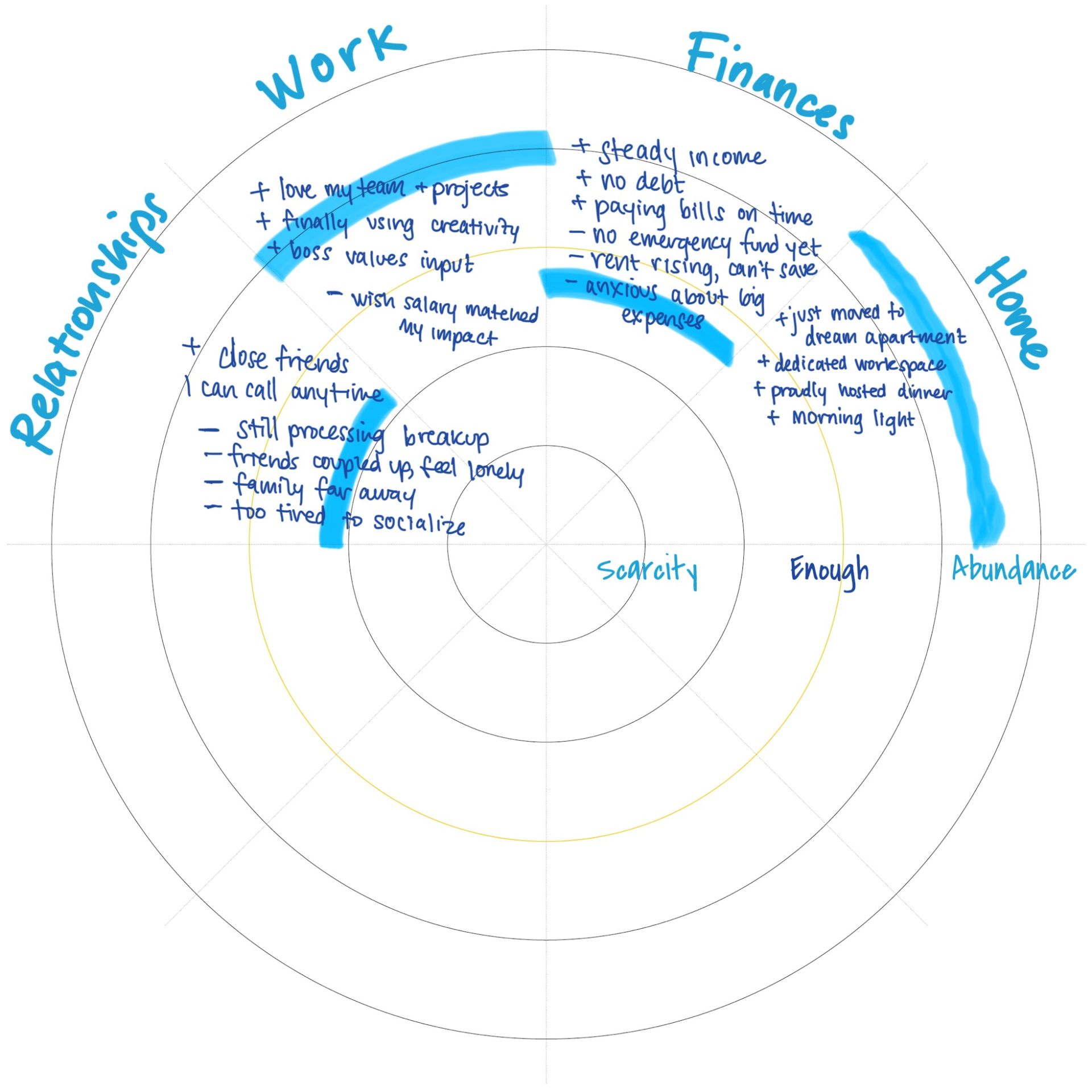
The wheel of life is one tool that can help us to consider other perspectives of ourselves and to do a gentle assessment of how satisfied we feel with other facets of our identity.
Here's an example:
Psychologists call this “enmeshment,” and while it’s not a disorder or a diagnosable problem, becoming aware of when we experience enmeshment helps us to untangle and shift.
Each time we step out of our comfort zone, into potential imposter syndrome, and potentially learn something new, we’re also stretching our sense of self and evolving our identity. It costs energy, and it equips us with skills and tools to confront the next challenge.
As you think about who you are other than a translator, linguist, project manager, or quality specialist, consider other ways of describing yourself, like your hobbies, interests, values, or other roles you might play in society.
The wheel of life is one tool that can help us to consider other perspectives of ourselves and to do a gentle assessment of how satisfied we feel with other facets of our identity.
Here's an example:
2. See Your Strengths and Opportunities Objectively
SWOT stands for Strengths, Weaknesses,
Opportunities, and Threats. It’s a simple, tried-and-true strategic analysis
tool in use in management consulting, which can be applied to organizations,
circumstances, and even people.
Jot down some of your self-perceived strengths and opportunities. (Our brains are wired for negativity, and it’s likely easier to name weaknesses and threats, so let’s concentrate on the S and O categories.) Explore questions such as:
● What do I consistently get positive feedback about in my work and life?
● What work do I so love doing that it doesn’t seem like work?
Ask others who know you well (friends, current and past colleagues, clients, and family) to help add to it, exploring questions like:
● What would you trust me to handle more than most anyone else?
● When you see me at my best, what am I doing?
● What would you miss most about me when I’m no longer in regular connection with you?
In partnership with your own “board of directors,” map or list your strengths and opportunities. With your personal SWOT analysis, you’ll be clear and ready to pursue and say yes to new opportunities that suit you well.
Jot down some of your self-perceived strengths and opportunities. (Our brains are wired for negativity, and it’s likely easier to name weaknesses and threats, so let’s concentrate on the S and O categories.) Explore questions such as:
● What do I consistently get positive feedback about in my work and life?
● What work do I so love doing that it doesn’t seem like work?
Ask others who know you well (friends, current and past colleagues, clients, and family) to help add to it, exploring questions like:
● What would you trust me to handle more than most anyone else?
● When you see me at my best, what am I doing?
● What would you miss most about me when I’m no longer in regular connection with you?
In partnership with your own “board of directors,” map or list your strengths and opportunities. With your personal SWOT analysis, you’ll be clear and ready to pursue and say yes to new opportunities that suit you well.
3. Align Yourself With The World
Disclaimer: Many
scholars have criticized the Western appropriation of the Japanese term
“ikigai” as an attempt to re-label a newly invented concept as something
Japanese. While the authentic Japanese meaning of the word is closer to
“feelings of happiness that come from being present in everyday moments,” some
practitioners have sought to suggest that through the ikigai, one can achieve a
single grand career or a life-altering purpose. Perhaps it’s worth setting the
linguistic and cultural origin debate aside to find meaning in the framework
itself.
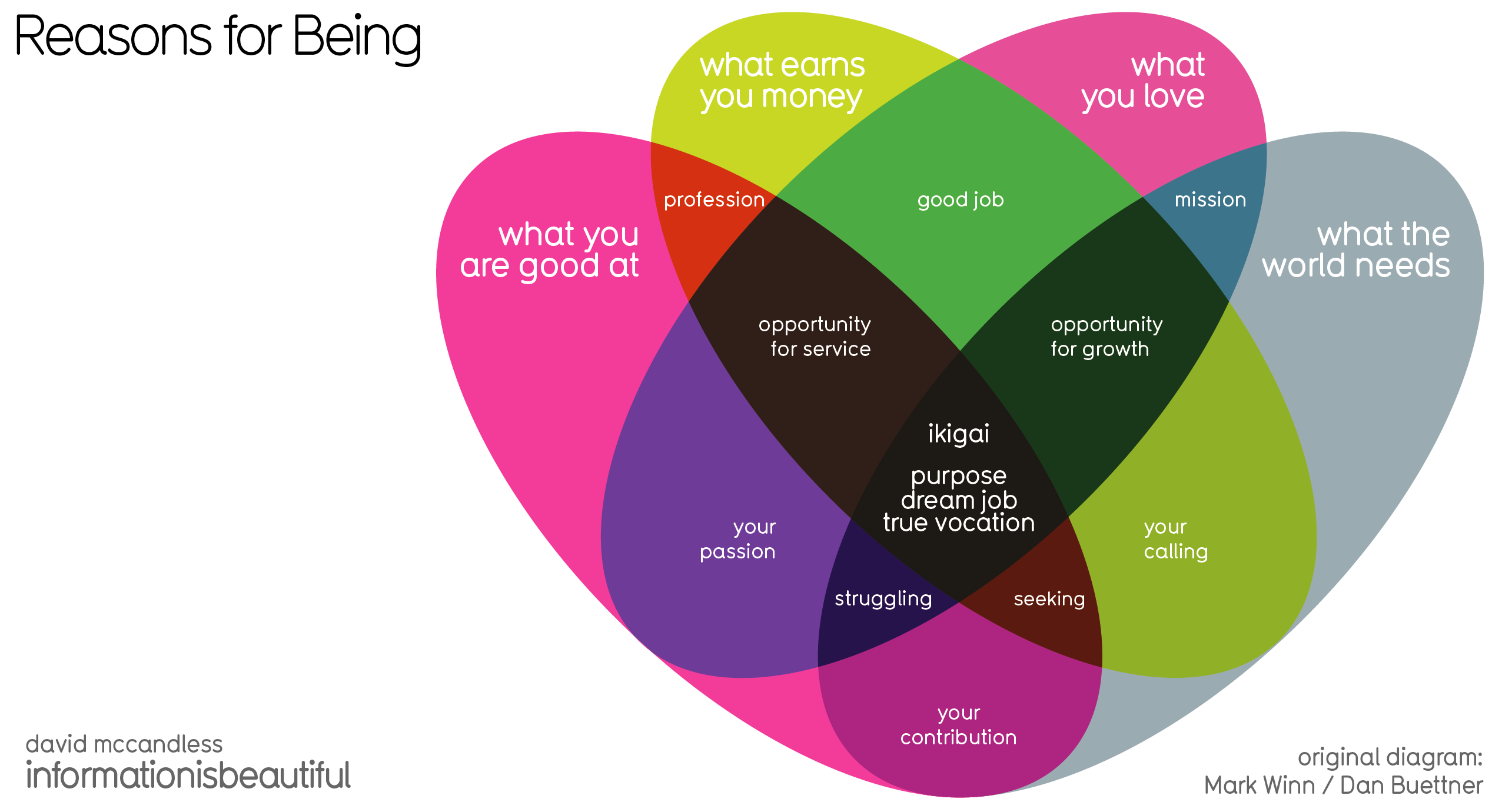
The modern personal-professional-development “ikigai” framework proposes answering:
● What do I love?
● What am I good at?
● What can I be paid for?
● What does the world need?
With answers to these questions, one can start to find commonalities, aiming toward finding professional activities that also align with an external mission, vocational strengths, and personal passion.
While many western appropriations suggest a fairly simple overlap of two Venn diagrams (4 circles, joined in the middle), personally, I’m a fan of the revised visual model created by informational designer David McCandless of Information Is Beautiful.
The modern personal-professional-development “ikigai” framework proposes answering:
● What do I love?
● What am I good at?
● What can I be paid for?
● What does the world need?
With answers to these questions, one can start to find commonalities, aiming toward finding professional activities that also align with an external mission, vocational strengths, and personal passion.
While many western appropriations suggest a fairly simple overlap of two Venn diagrams (4 circles, joined in the middle), personally, I’m a fan of the revised visual model created by informational designer David McCandless of Information Is Beautiful.
4. Learning and Earning: Know the Differences
Common career wisdom suggests that we should
either be learning or earning.
Learning: In the cycles of growth and change that are necessary for our human and societal development, we may have moments where we’re stretched, trying things we’ve not done yet. The word “yet” helps to acknowledge that we have the capacity to grow and evolve. The more we pay attention to what we can learn, the more we can be equipped for the next challenge.
Earning: In the wise words of writer Elizabeth Gilbert, a job is a part of the social contract to take care of ourselves. Hobbies, a career, and a vocation are all optional possibilities. So far, in the 21st century world, humans still need to secure financial means to subsist.
Sometimes we find ourselves in professional positions that we’re able to both learn and earn. That’s great.
If you’re neither earning nor learning, the professional wisdom is to shift what you’re doing. Let yourself evolve.
Feeling lost in the world of AI? Do you feel robbed of your once noble and dignified profession? If your sense of self is deeply enmeshed with a linguistic career that feels near-extinction, join me in my expert course for TranslaStars Navigate AI to Reclaim Your Localization Career, coming up on the 10th of February.
Learning: In the cycles of growth and change that are necessary for our human and societal development, we may have moments where we’re stretched, trying things we’ve not done yet. The word “yet” helps to acknowledge that we have the capacity to grow and evolve. The more we pay attention to what we can learn, the more we can be equipped for the next challenge.
Earning: In the wise words of writer Elizabeth Gilbert, a job is a part of the social contract to take care of ourselves. Hobbies, a career, and a vocation are all optional possibilities. So far, in the 21st century world, humans still need to secure financial means to subsist.
Sometimes we find ourselves in professional positions that we’re able to both learn and earn. That’s great.
If you’re neither earning nor learning, the professional wisdom is to shift what you’re doing. Let yourself evolve.
Feeling lost in the world of AI? Do you feel robbed of your once noble and dignified profession? If your sense of self is deeply enmeshed with a linguistic career that feels near-extinction, join me in my expert course for TranslaStars Navigate AI to Reclaim Your Localization Career, coming up on the 10th of February.
Conclusion
With more than 300 courses, including many
focused on AI-based workflows and skills, TranslaStars aims to support the
localization community to discover, learn, and grow. If you’re looking to learn
or earn more, you can count on our community of experts to support your
professional advancement.
By focusing on our unique human capacity for adaptation, we can confidently navigate the ever-evolving localization industry. Join the VI Edition of our Localization Management Program, taking place next March.
By focusing on our unique human capacity for adaptation, we can confidently navigate the ever-evolving localization industry. Join the VI Edition of our Localization Management Program, taking place next March.
Re-evaluating
your identity, strengths, the needs of the world, and your own possibilities to
learn and earn provides powerful and practical frameworks for growth.
The most potent tool in this evolving industry is not a new algorithm or LLM, but our own willingness to evolve. Humans have always been the key agents in advancing the language industry, and the next, most successful iteration of localization will be shaped by our proactive choices to adapt and thrive.
The most potent tool in this evolving industry is not a new algorithm or LLM, but our own willingness to evolve. Humans have always been the key agents in advancing the language industry, and the next, most successful iteration of localization will be shaped by our proactive choices to adapt and thrive.
Meet the Author
Stephen Nock
Stephen is an ICF-accredited coach and
teamwork facilitator who helps leaders, teams, and professionals who want to do
better work - and live better lives - in a complex, changing world.
Write your awesome label here.
If you liked this article, read also:




Courses
Free Courses/Resources
LMA
TranslaStars University
Media Library
Contact
Support / Help / Documentation
Data