
The translation industry is in the middle of a fundamental transformation. Artificial intelligence has moved from a novel experiment to a core production tool, and the role of the human linguist is being redefined in real time. For many post-editors and translators, this shift has felt threatening: rates are compressing, turnaround times are shrinking, and the market can seem to be moving in one direction, cheaper and faster, with less room for human expertise. But there is another side to this story. A growing number of language professionals are earning more than ever before, not less, because they have figured out something that most of the industry has not yet caught up with: AI creates new quality problems that only skilled linguists can solve, and the professionals who understand those quality problems have become the most valuable part of the AI-assisted localization workflow.
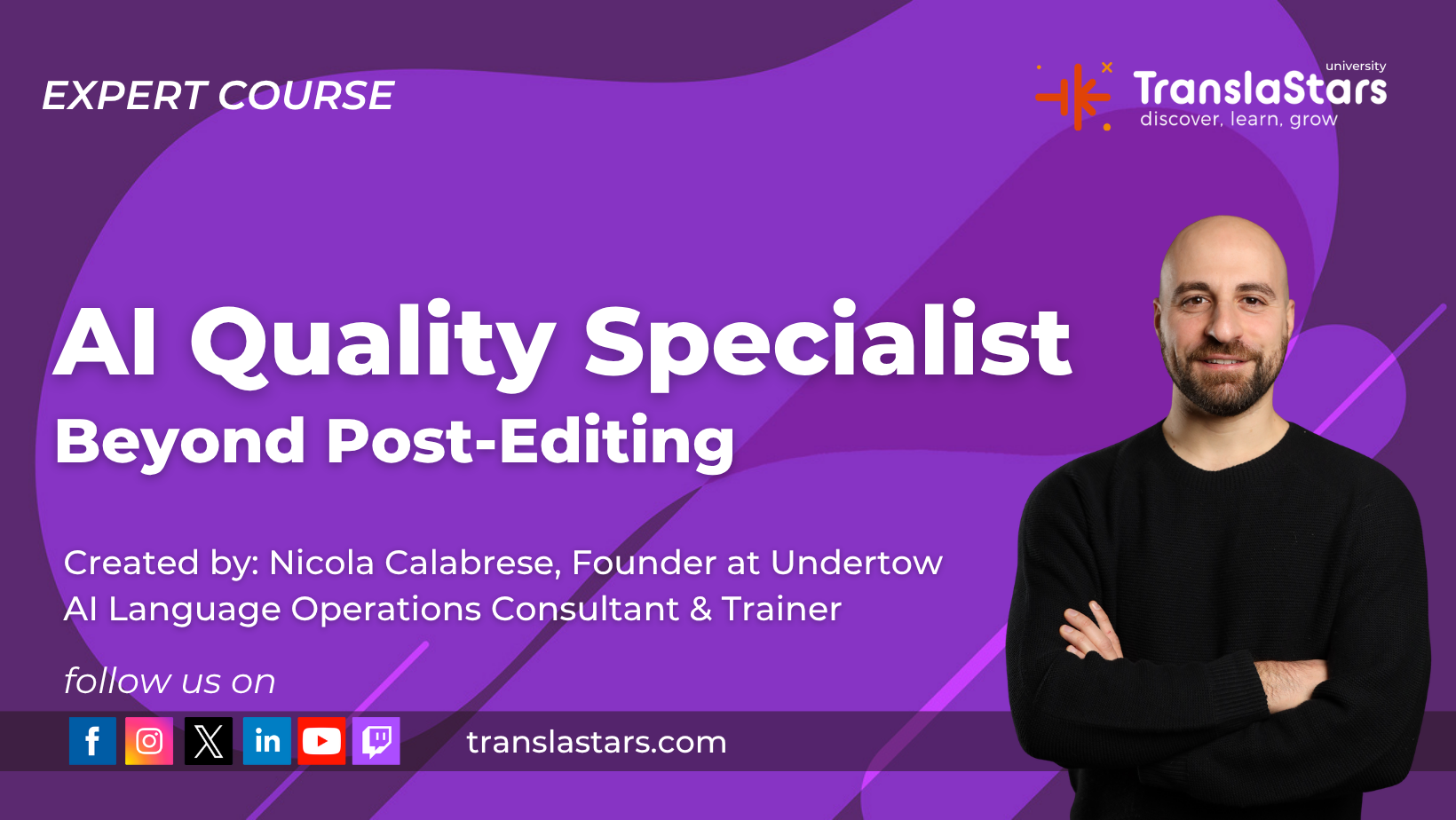
This comprehensive guide is based on the three-session course From Post-Editor to AI Quality Specialist taught by Nicola Calabrese, founder and CEO of Undertow, at TranslaStars University. The course, delivered over six hours in May 2026, provides a practical, actionable framework for making the transition from reactive post-editing to proactive quality leadership.
In This Guide
- 1. The Market Opportunity: Why Now?
- 2. The Four Pillars of an AI Language Quality Specialist
- 3. The Four-Asset Toolkit
- 4. Understanding AI Error Patterns: The Taxonomy
- 5. Positioning and Selling AI Quality Services
- 6. Handling Common Objections
- 7. Rewriting Your Positioning
- 8. The First 30 Days as an AI Quality Specialist
- 9. Live Demo: How One Glossary Entry Changes AI Output
- 10. Frequently Asked Questions
1. The Market Opportunity: Why Now?
According to Nimdzi Insights, the global language services market exceeds $68 billion, and AI-enabled workflows have become central to multilingual content delivery. But here is the critical insight: the quality gap is widening. Companies adopting AI translation at scale are discovering that the output requires a new kind of linguistic oversight that traditional translation workflows were never designed to provide. The linguists who understand this gap and can bridge it are stepping into roles that did not exist even two years ago.
The market is shifting in three key directions. First, post-editing is being commoditized; rates are compressing, and volume becomes the only competitive lever, which is a race to the bottom. Second, real quality work is scarce; most teams ship AI output without any systematic quality controls, leaving a wide gap open for specialists. Third, the few professionals who can manage the system rather than just fix individual strings become hard to replace. Scarcity combined with skill creates a hard-to-replace position. Clients are not buying edits; they are buying brand consistency at scale across every market and channel, scalable AI workflows that improve over time, and risk reduction against costly mistranslations in regulated or high-visibility markets.
The professionals who understand AI quality problems have become the most valuable part of the AI-assisted localization workflow. The quality gap is widening, and the linguists who can bridge it are stepping into roles that did not exist two years ago.
2. The Four Pillars of an AI Language Quality Specialist
Nicola Calabrese's framework organizes the AI Quality Specialist role into four distinct pillars, each with a specific time allocation and set of responsibilities. This structure transforms the work from unstructured editing into a systematic, measurable quality program.
Pillar A: High-Impact Review (45% of time)
This is the largest time allocation, but it is fundamentally different from traditional post-editing. High-Impact Review means reviewing strategically: focus on critical product flows, high-traffic help pages, and key campaigns rather than every single string of content. Batch related strings together to spot terminology drift and tonal shifts that would be invisible when reviewing strings in isolation. Every edit must be annotated with a reason; your annotations become the AI's training signal. The fundamental mindset shift is this: the goal is not just to fix today's output but to make tomorrow's output need less fixing. Each annotation feeds back into the system, improving future translations at scale.
Pillar B: Linguistic Assets for an AI World (25% of time)
Most translation glossaries and style guides were written for human consumption. They are full of rationale, history, and brand philosophy spread across 40-page PDFs that AI systems simply ignore because they are too long, too vague, and not structured for machine parsing. The role of the AI Quality Specialist is to rebuild these assets for an AI-driven workflow. Upgrade glossaries with preferred terms, forbidden terms, usage context, and in-context examples that include disambiguation rules. Rewrite tone guides replacing vague guidance with explicit before-and-after examples. Create AI instruction sheets: one short structured text per language and content type, ready to paste into the TMS AI prompt settings. Keep all assets current; every error pattern discovered during Pillar C analysis is a potential asset update.
Pillar C: Error Analysis and Feedback Loop (20% of time)
Error Analysis and Feedback is the diagnostic engine of the quality system. Sample AI output proactively from content streams, finding issues before they reach end users. Categorize every error by type using a structured taxonomy: tone and register drift, over-literal output, gender and number errors, context blindness, terminology misuse, brand terminology violations, and hallucinated content. Build an error library with one entry per example; patterns become visible across entries, not within them. Once patterns are identified, the specialist recommends configuration changes: glossary updates, prompt rule adjustments, or model selection changes. This is where the role moves from reactive to systemic.
Pillar D: Stakeholder Communication (10% of time)
Quality work that is invisible to stakeholders is quality work that will not be valued or funded. The AI Quality Specialist must translate findings for non-linguists. Product teams care about user outcomes, not linguistic categories, so frame quality issues in terms of user experience impact. Send a monthly one-pager covering three recurring issues, actions taken, and one before-and-after example. Set up an intake process allowing submitters to nominate priority content with clear SLAs. A regular quality report is proof that the role is effective and improving the program, positioning the specialist as a strategic partner rather than a cost center.
Key insight: The four-pillar framework rebalances the workload from 100% reactive editing to a strategic mix where 55% of time is spent on assets, analysis, and communication — work that compounds in value and makes you indispensable to the team.
3. The Four-Asset Toolkit
Session 2 of the course focuses on building the four core assets that every AI Quality Specialist needs to own and manage. These assets are the tangible deliverables that transform quality from an abstract concept into a repeatable system.
Asset 1: The Living Glossary
A glossary is not a word list. A living glossary is a decision engine. It includes context notes per term telling the AI when and where each term applies, not just what it means. Disambiguation rules provide explicit guidance for choosing the correct target word based on context: for example, “account” in a platform context versus “account” in a billing context should map to different target-language terms. A do-not-translate list protects brand names, product names, and legal terms. Forbidden terms flag words the client never wants to see: competitor names, deprecated product names, or culturally offensive equivalents. The glossary is “living” because it gets updated every time LQA finds a new pattern, growing smarter with every project cycle.
Asset 2: The Style Guide AI Can Follow
The crucial insight from the course is that most style guides fail with AI because they are written for humans. The AI-ready style guide is not a 40-page PDF; it is an eight-line AI brief covering audience (who reads this), tone (how it should feel), forbidden phrasing (what to avoid), and two to three short examples that show rather than tell. The goal is not to summarize the full style guide but to extract the rules an AI can actually act on. Same brand voice, but in a format the AI can parse and apply consistently.
Asset 3: The Prompt as a Quality Document
The prompt is perhaps the single most powerful tool in the AI Quality Specialist's arsenal. A bad prompt treats the instruction as a search query: “Translate this text into Italian.” No role, no context, no constraints, no examples. The AI makes every decision itself, and it will make the wrong decisions. A good prompt assigns a role (“You are a professional translator for a B2B SaaS company”), provides audience information (“IT managers in Italy”), sets tone constraints (“direct, no marketing fluff”), includes glossary rules (“Use ‘account’ for customer accounts, ‘conto’ for billing”), specifies do-not-translate terms, and includes two to three example pairs showing the desired output. Every quality prompt has four components: role, context, constraints, and examples. Miss one, and the AI fills the gap with guesswork.
Asset 4: The LQA Framework
You cannot improve what you do not measure. The LQA (Language Quality Assessment) framework makes quality visible and quantifiable. A structured scorecard evaluates translation output against defined quality standards, categorizes errors by severity, and tracks improvement over time. The LQA framework turns subjective quality judgments into objective, actionable data that drives system improvements and demonstrates value to stakeholders.
4. Understanding AI Error Patterns: The Taxonomy
A structured error taxonomy is the foundation of systematic quality management. The course identifies six primary error categories that AI systems consistently produce.
Tone & Register Drift
Technically correct output that does not match brand voice or register. Fix: rewrite the tone brief in machine-readable format.
Over-Literal Output
AI defaults to literal meanings of ambiguous words. Fix: better glossary disambiguation rules.
Context Blindness
AI has no awareness of where a string appears. Fix: provide UI metadata in the prompt.
Brand Terminology Errors
Glossary fails to lock preferred terms. Fix: lock terms in glossary.
Gender & Number Errors
Issues in languages with grammatical gender. Fix: explicit prompt rules.
Hallucinated Content
AI invents information not in the source. Fix: system-level model selection or validation protocols.
Tone and Register Drift occurs when the AI produces technically correct output that does not match the brand voice or the expected register, changing a casual SaaS message into overly formal corporate language. Over-Literal Output happens when the AI defaults to literal meanings of ambiguous words: translating “bug” as an insect instead of a software defect. Context Blindness means the AI has no awareness of where a string will appear, so a button label reading “Open draft” becomes “Open the draft document” because the AI expanded it into a sentence. Brand Terminology Errors occur when the glossary fails to lock in preferred terms, causing the AI to substitute near-synonyms. Gender and Number Errors appear in languages with grammatical gender and formal versus informal address forms. Hallucinated Content represents the most serious category: the AI invents information that does not exist in the source text.
Each error type has a specific upstream fix. Tone drift is fixed by rewriting the tone brief in a machine-readable format. Over-literal output requires better glossary disambiguation. Context blindness is addressed by providing UI metadata in the prompt. Brand terminology errors require locking preferred terms in the glossary. Gender and number errors need explicit prompt rules. Hallucinations require system-level model selection or post-generation validation protocols.
5. Positioning and Selling AI Quality Services
What to Sell: Three Service Packages
The course recommends three service models that map to different client relationships and budget cycles.
The Audit — A one-time engagement providing a snapshot of what is broken and how to fix it, with clear scope and a clear deliverable. The easiest door to open.
The Retainer — A monthly arrangement with ongoing quality work on a fixed scope, providing predictable income for the specialist and predictable quality for the client.
The Project — A defined deliverable tied to a product release or campaign, with a scoped start and end and a rate agreed upon before launch.
Start with the Audit. It is the most accessible entry point for building client relationships.
How to Price
The fundamental pricing insight is to stop trading time for money. Hourly pricing caps your ceiling: more skill means faster work means less pay. The model punishes expertise. Deliverable pricing (fixed price per asset or audit) means your efficiency becomes profit rather than a penalty. Outcome pricing tied to measurable results such as fewer LQA errors or faster turnaround is where premium pricing lives. Move up the ladder when you can, but start at deliverable pricing on your very next project.
The Three-Sentence Pitch
A successful pitch communicates three things. First, who you help: be specific about the type of company and team. “SaaS companies with multilingual content teams” is more memorable than “businesses.” Second, what you fix: name the specific problem plainly, such as “AI output that sounds off-brand” or “LQA error rates that keep climbing.” Third, how they know it worked: the measurable change, such as “fewer revision rounds,” “LQA scores above threshold,” or “brand voice consistent across five markets.” Three sentences. That is the pitch. Everything else is detail you add when they ask.
6. Handling Common Objections
Clients will raise objections. The key is to prepare responses that demonstrate understanding and provide reassurance. If a client says they already have a glossary, the response is that a glossary and a living glossary are different things, and you can show them the difference in a 30-minute audit. If they worry about cost, frame it as the cost of not having quality: one bad translation in a regulated market or a viral mistranslation can cost far more than your entire fee. If they doubt their AI output needs human oversight, offer a free sample audit of 20 strings with a before-and-after comparison. Each objection is an opportunity to demonstrate value rather than defend a price.
“If a client says they already have a glossary, the response is that a glossary and a living glossary are different things, and you can show them the difference in a 30-minute audit.” — Nicola Calabrese
7. Rewriting Your Positioning
The course provides a three-shift framework for repositioning yourself. Shift from listing skills to describing outcomes: not “MTPE specialist” but “helps SaaS companies ship multilingual products with consistent quality.” Shift from being generic to being specific: not “any field” but “SaaS, e-learning, fintech.” Shift from asking for trust to providing evidence: not “trust me” but “clients see fewer translation errors and faster release cycles.” The same translator, but a completely different perceived value.
8. The First 30 Days as an AI Quality Specialist
The practical action plan from the course provides a clear roadmap for launching this career. Start by conducting a self-assessment of your current assets and the quality gaps in your existing workflow. Here is a practical action plan for launching this career:
- Assess your current assets: what glossaries, style guides, and prompts do you already manage?
- Conduct a quality audit of AI output from a recent project, creating an error library with at least ten categorized examples.
- Rewrite one glossary entry for AI use and compare the before-and-after output.
- Create a one-page sample report you can show to potential clients.
- Update your LinkedIn profile and bio with the repositioned messaging.
- Send your audit proposal to three past or potential clients.
The transition from post-editor to AI Quality Specialist is not theoretical; it is a concrete, step-by-step process of building the toolkit, demonstrating the value, and selling the outcome.

9. Live Demo: How One Glossary Entry Changes AI Output
One of the most powerful demonstrations in the course involves showing how a single rewritten glossary entry can transform AI output in real time. Consider the term “workspace” in a B2B SaaS product. Before the glossary lock-in, the AI might translate “Invite your team to your workspace” as “Invite your team to your account” in Japanese, substituting a near-synonym that breaks the brand's naming convention. After the glossary is updated to lock “workspace” as the preferred term and add the context note that this is the product's name for a collaborative team environment, the AI correctly uses the target-language equivalent of “workspace” every time. This demo makes visible what quality specialists know: the most powerful quality lever is not editing output but improving the assets that produce it.
10. Frequently Asked Questions
What exactly does an AI Quality Specialist do?
An AI Quality Specialist is a language professional who manages the quality of AI-generated translations at a systemic level. Rather than editing strings one by one, they build and maintain the assets (glossaries, style guides, prompts, LQA frameworks) that improve AI output at scale, analyze error patterns to diagnose root causes, and communicate quality metrics to stakeholders.
Do I need to be a programmer or have technical skills?
No. The AI Quality Specialist role is a linguistics-first position. You do not need to code, configure models, or understand API architecture. What you need is strong linguistic judgment, the ability to structure information for AI consumption, and the communication skills to translate quality findings for non-linguist stakeholders.
How is this different from being a post-editor?
Post-editing is reactive and transactional: you fix output that has already been generated, one string at a time. The AI Quality Specialist role is proactive and systemic: you improve the conditions under which AI produces output, so the output needs less fixing over time. The specialist works upstream of the post-editor.
Can I transition to this role while still taking on post-editing work?
Absolutely. The course recommends starting with a single audit project for one client while maintaining your current workflow. Build the toolkit gradually, demonstrate results with one client, and expand from there. The transition does not require quitting your current work overnight.
What should I charge for AI quality services?
Start with deliverable pricing: fixed price per audit, per glossary rewrite, or per LQA framework setup. The course notes that specialists typically charge 2-3x their post-editing hourly rate when shifting to deliverable-based pricing, because the value delivered (systemic improvement) far exceeds the time invested.
Which industries need AI Quality Specialists most urgently?
SaaS companies with multilingual products are the highest-demand segment right now, followed by e-learning platforms, fintech, e-commerce marketplaces, and gaming. Any industry shipping content across multiple languages with AI translation tools is a potential client.
Do I need a specific certification to offer these services?
No formal certification is required. Clients care about results, not credentials. The From Post-Editor to AI Quality Specialist course at TranslaStars University provides the framework and methodology, but your portfolio of audits and quality improvements will be your strongest credential.

Conclusion
The translation industry is not shrinking; it is restructuring. The demand for human linguistic expertise is not disappearing; it is shifting from reactive string-by-string correction to proactive system-level quality management. The AI Language Quality Specialist role represents the most significant career opportunity for language professionals in a generation.
By mastering the four-pillar framework, building the four-asset toolkit, learning to position and sell quality services, and taking actionable steps toward this new role, translators and post-editors can transform their careers and become the most valuable professionals in the AI-assisted localization workflow. The TranslaStars University course From Post-Editor to AI Quality Specialist by Nicola Calabrese provides the comprehensive training, practical frameworks, and real-world strategies needed to make this transition successfully.
Ready to take the next step? Explore the full course and begin your transition from post-editor to AI Quality Specialist today.




Courses
Free Courses/Resources
LMA
TranslaStars University
Media Library
Contact
Support / Help / Documentation
Data