
Content Strategy • AEO • GEO
Your Multilingual Content Is Invisible to AI. Here's How to Fix It.
Search has two audiences now. One still types keywords into Google and browses the results. The other asks a question to ChatGPT, Claude, Perplexity, or Google's AI Overviews and expects a direct answer. If your multilingual content only satisfies the first audience, you are invisible to the second. And the second audience is growing fast.
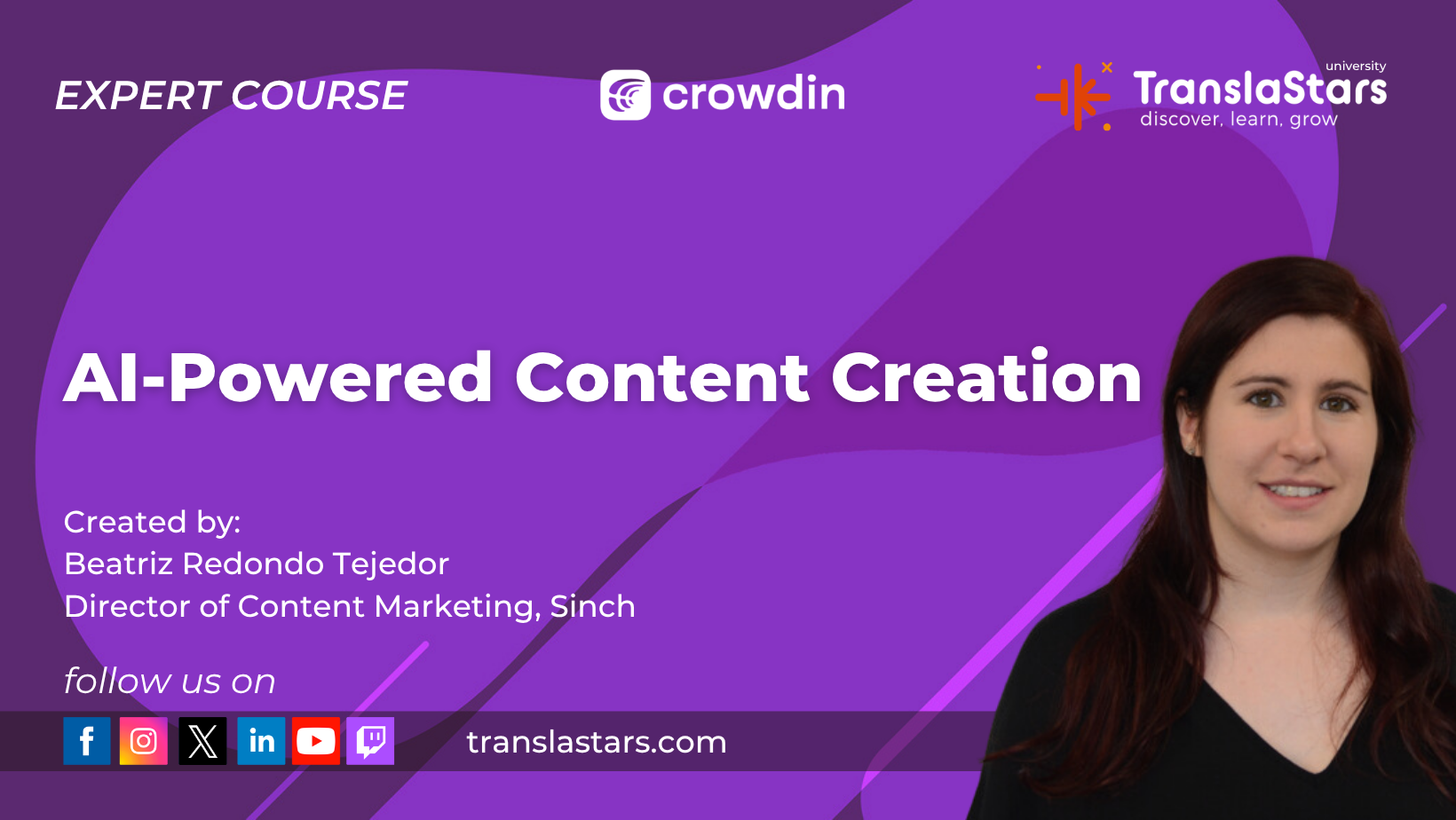
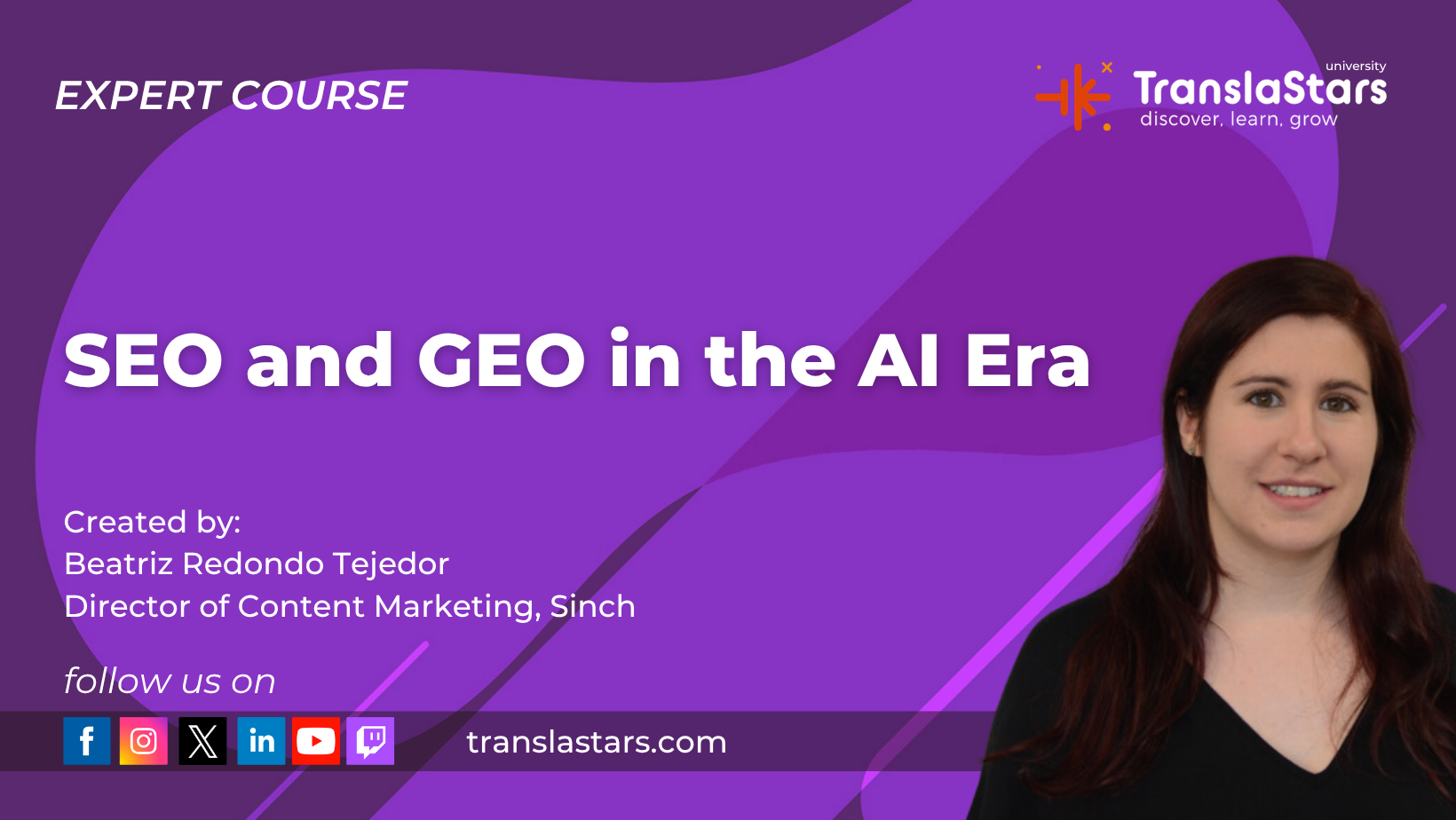
This guide covers the practical frameworks you need to optimize multilingual content for both worlds: traditional search engines and generative answer engines. It draws on the expertise of Beatriz Redondo, a multilingual content and AI strategist with over a decade leading content and localization teams at global organizations, who teaches on this topic through her courses SEO and GEO in the AI Era and AI-Powered Content Creation, part of the AI Multilingual Operations Strategist program on TranslaStars.
Table of Contents
Why Search Has Two Audiences Now
Google still matters. But ChatGPT, Perplexity, Claude, and Gemini are now answering questions that used to drive search traffic, and they have their own rules for what content they surface. Roughly 60% of searches on Google now end with no click. Impressions rise while clicks decline. This is not a temporary shift, it is a permanent change in how people find information.
Generative Engine Optimization (GEO) is the emerging discipline that bridges both worlds. It builds on what you already know about SEO (ranking signals, content structure, search intent) and extends it into what AI models actually reward: authoritative sources, clear entity relationships, structured data, and content that answers questions directly rather than just ranking for keywords.
For multilingual content professionals, this shift creates both a challenge and a structural advantage. The challenge: you now need to optimize content for AI models in every language you operate in, and each language's content is evaluated independently. The advantage: you already understand how content travels across languages, cultures, and contexts, which is exactly the skill that AI models need you to apply to their training and retrieval systems.
Core concept: AEO (Answer Engine Optimization) focuses on getting your content extracted as a direct answer. GEO (Generative Engine Optimization) is broader - it optimizes for how generative AI models retrieve, understand, and remix your content when generating responses. Both matter, and neither replaces traditional SEO. They add layers on top of it.
Translate vs Adapt vs Create: The Content Routing Framework
One of the most practical frameworks for multilingual content is the three-lane model. Most teams fail at multilingual content because they have a single workflow for all content types. The solution is to separate content into lanes based on what it needs to achieve in each market.
The framework is simple, but most teams do not apply it because they have a single workflow for all content. The fix is to build routing rules that automatically direct content to the right lane based on content type, audience, and strategic importance. Beatriz Redondo covers this framework with real case studies in her SEO and GEO in the AI Era course, showing how to implement routing at scale across dozens of markets.
What GEO Is and What AI Models Actually Reward
GEO is not a new SEO strategy with a different name. It is a distinct discipline because AI models process content differently than search engine crawlers. Understanding how AI models decide what to surface and cite is the first step in optimizing for them.
Entity Optimization: The Foundation of GEO
Search engines match keywords. AI models match entities - people, places, concepts, products, and their relationships. If your content establishes clear entities and their connections, an AI model can retrieve it more reliably. If your content is a wall of text with no entity structure, the model treats it as noise.
Practical entity optimization means: define the subject explicitly, use consistent terminology to refer to it throughout, connect related entities through clear internal linking and semantic markup, and establish authority by linking to trusted sources and being cited by others.
E-E-A-T for Both SEO and GEO
Experience, Expertise, Authoritativeness, and Trustworthiness (E-E-A-T) are critical for both traditional SEO and GEO, but AI models evaluate them differently. For GEO, E-E-A-T signals include: content that cites sources, content written or reviewed by recognized experts in the field, content that is consistently referenced by other authority sites in the same language, and content with clear authorship and publication dates.
"A well-translated page that lacks proper heading hierarchy, semantic markup, and topical depth will be invisible to answer engines in that language, even if it ranks on Google."
Structured Data and Semantic Markup
Structured data (schema.org markup) is one of the strongest GEO signals because AI models parse it directly. If your content uses FAQ schema, HowTo schema, Article schema, and Product schema correctly, the AI model has a clear map of what your content contains. Without it, the model has to guess.
For multilingual content, this means: every language version needs its own structured data, pointing to the correct language-specific content. Hreflang tags tell the engine which language version to surface for which audience, but structured data tells the engine what the content means.
Content Structure and Direct Answers
Generative AI models favor content that is structured for extraction. Clear headings that pose questions, concise paragraphs that answer those questions directly in the opening lines, and bullet lists or numbered steps for processes all make it easier for AI models to retrieve and cite specific sections of your content.
This is especially important for multilingual AEO. An answer engine does not translate your English paragraph and serve that to a Spanish-speaking user. It retrieves your Spanish content directly, if it exists and if it is structured correctly. Every language version needs to be independently optimized for extractability.
Multilingual GEO: What Changes Across Languages
This is where most teams make their biggest mistake. They assume that optimizing the English version is sufficient and the translated versions will inherit the SEO and GEO value. They do not.
AI models evaluate each language version independently. The Spanish version of your page competes against all other Spanish-language content on the same topic. If the Spanish version has weak structured data, no topical depth, and low authority signals, it will not be surfaced in AI responses, regardless of how well the English version performs.
The practical implications are:
- Structured data per language: Every language version needs its own schema markup pointing to its own URL. Do not use the English schema as a template and forget to update the language identifiers.
- Independent authority building: Backlinks and citations in Spanish build authority for the Spanish version. Backlinks in English do not flow authority to other languages.
- Language-specific entity recognition: The same entity may be referred to differently in different languages. Your content needs to use the locally recognized terminology for the entity to be identified correctly.
- Topical depth in each language: A paragraph of translation does not equal topical depth. Each language version needs its own comprehensive treatment of the subject to be considered authoritative.
Key insight: The three-lane content routing framework applies here too. Content in the Translate lane may not need full GEO optimization. Content in the Adapt and Create lanes absolutely does, because that is the content that drives visibility and conversion in each market.
Practical Steps for GEO Readiness
Here is what you can start implementing today. These steps are drawn from Beatriz Redondo's framework and apply whether you manage content for a single language pair or dozens of markets.
- Understand what GEO is and how it differs from SEO. SEO optimizes for crawlers that index links. GEO optimizes for AI models that retrieve answers. The two overlap but are not the same. Start by auditing which of your content types are optimized for one, the other, or both.
- Audit your content routing. Map every content type you produce to the Translate, Adapt, or Create lane. If everything is in one lane, you are overpaying for some content and underinvesting in others. This is the single highest-leverage change you can make.
- Master content structure and entity optimization for AI models. Use clear headings, consistent terminology, and explicit entity relationships. Every page should answer one primary question and two to three related questions directly in the opening paragraphs.
- Apply E-E-A-T signals for both SEO and GEO. Include author bylines, publication dates, cited sources, and expert credentials. These signals build trust with both traditional search engines and generative models.
- Implement structured data and semantic markup for multilingual content. Every language version needs its own schema.org markup with correct language attributes. FAQ schema, Article schema, and HowTo schema are the highest-value for GEO.
- Run a GEO audit per language. Check how your content performs in generative engine responses for each language. If a language has zero visibility in ChatGPT or Perplexity, the fix is structural and topical, not linguistic. Tools like Ahrefs and Semrush can help identify content gaps across languages.
- Build a repeatable optimization workflow. Document your prompt structures, review workflows, and quality criteria so teams can run them consistently. The goal is a system that improves over time, not a one-time exercise.
FAQ
Do I need to rebuild my entire multilingual content strategy?
No. The most effective approach is to apply the three-lane routing framework first, then optimize the Adapt and Create lanes for GEO. The Translate lane can stay on your existing workflow while you build GEO capability for your high-value content.
What is the difference between AEO and GEO?
AEO (Answer Engine Optimization) focuses on getting your content extracted as a direct answer. GEO (Generative Engine Optimization) optimizes for how generative AI models retrieve, understand, and remix your content. AEO is a subset of GEO; GEO includes everything from entity optimization to structured data to authority building.
Is GEO only relevant for English content?
No, the opposite. GEO is arguably more important for non-English content because the competitive landscape is different. Fewer multilingual teams apply GEO principles, which means early adopters in Spanish, French, German, Portuguese, and other languages have a significant first-mover advantage.
Do I need separate SEO tools for GEO analysis?
Tools like Ahrefs and Semrush are useful for both, but GEO analysis is different. You need to check not just search rankings but actual AI response visibility. Beatriz Redondo's courses cover live demonstrations of how to use these tools for GEO analysis, including MCP (Model Context Protocol) integrations for AI-assisted keyword and intent analysis.
How long does it take to see results from GEO optimization?
GEO improvements can show results faster than traditional SEO because AI models update their knowledge bases more frequently than search engine indexes. Basic structural optimizations (structured data, direct answers, entity clarity) can show impact within weeks.
Deepen Your Skills: Take the Full Course
This guide covers the essential frameworks, but implementing GEO for multilingual content requires practice and hands-on experience with real tools. Beatriz Redondo teaches these concepts through two dedicated courses as part of TranslaStars' AI Summer Camp: AI Multilingual Operations Strategist program:
- SEO and GEO in the AI Era - Learn why search behavior has changed, how AI search differs from past search features, how each major AI tool behaves differently in practice, and concrete technical recommendations for adapting your SEO strategy. Covers entity optimization, E-E-A-T signals, structured data, multilingual GEO challenges, and live demos with Ahrefs MCP integration. Part of the Summer Camp program. 14-15 December 2026.
- AI-Powered Content Creation - A two-part workshop on using generative AI for content in localization contexts. Covers AI's real strengths and limitations, prompt engineering fundamentals, and building custom tools (Claude Projects, Skills, Custom GPTs, Gemini agents) tailored to content localization and brand-voice workflows. Part of the same program. 10-11 December 2026.
Master Multilingual Content Strategy for AI Search
Get Beatriz's complete framework: content routing, entity optimization, structured data, GEO audits, and AI-assisted keyword analysis in her two dedicated courses.
SEO and GEO in the AI Era → | AI-Powered Content Creation →
Both courses included in the AI Multilingual Operations Strategist program.



Courses
Free Courses/Resources
LMA
TranslaStars University
Media Library
Contact
Support / Help / Documentation
Data