
Reliable AI translation and the new roles it creates
A free two hour recorded session with Edwin Trebels and Viveta Gene. Learn what knowledge graphs are, when they help, and how they make AI translation reliable. No cost, no registration fee.
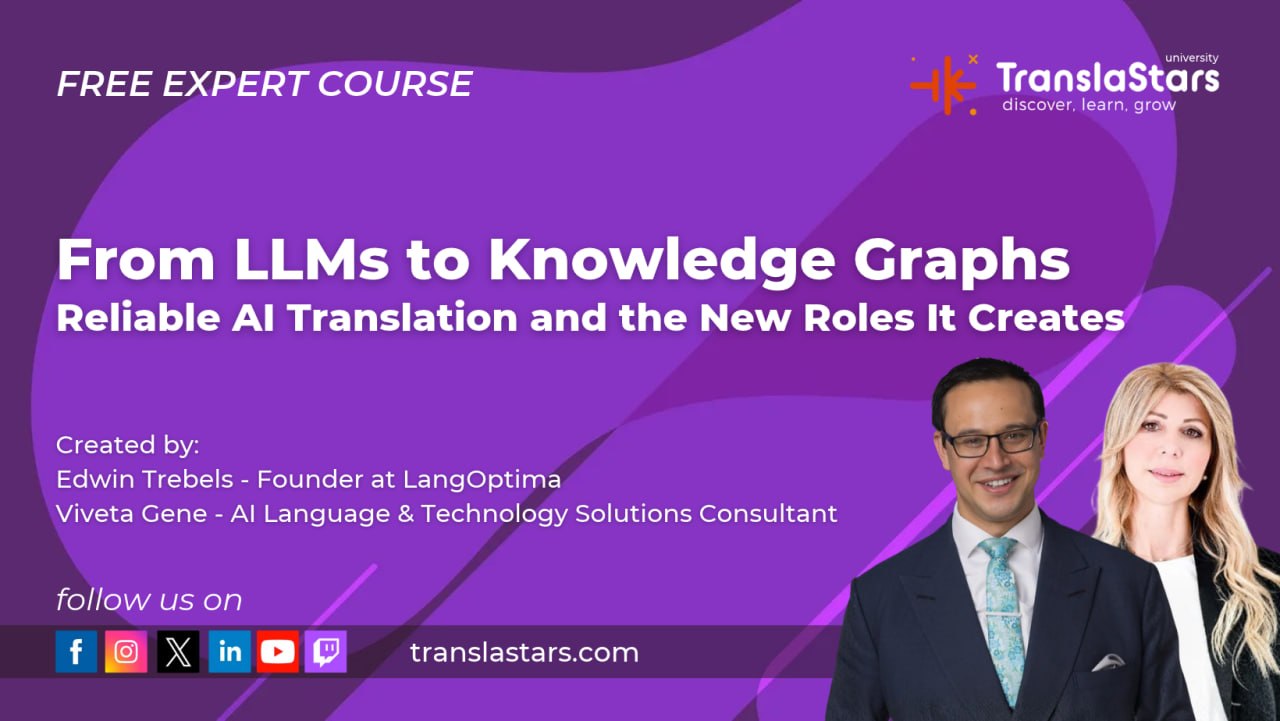
Turn messy data into a shared language for people, processes and AI
Knowledge graphs connect people, processes and data into a shared language that software can understand. Done well, they reduce integration friction, unlock analytics across silos, and make AI systems more explainable and reusable.
This free two hour session is available on demand and shows you a practical path. Edwin Trebels and Viveta Gene demystify the core concepts and tie them to everyday use cases, from customer 360 to AI grounding. Watching it is free and there is no registration fee.
Three outcomes that make graphs worth the effort
A knowledge graph is not a diagram on a whiteboard. It is infrastructure that makes your data usable, explainable and reusable.
AI-ready context
Provide authoritative, explainable context for LLMs, machine translation, agents and search.
Business outcomes
Shorten time to insight and enable new connected products and services.
Faster integration and reuse
Break data silos with a shared semantic layer instead of bespoke pipelines.
What you will walk away with
By the end of the session you will be able to explain the value of knowledge graphs and judge where they fit in your own localization and data landscape.
A plain language definition of knowledge graphs: entities, relationships and semantics.
A clear view of when graphs help, and where point to point integrations still make sense.
Common business use cases across industries: customer 360, product catalogs, supply chain, risk and compliance, and AI grounding.
An overview of KGMT and what running knowledge graph management at scale involves.
Language you can use with stakeholders to explain value, scope and next steps.
A practical starting point for preparing your data for AI use cases and machine translation.
Foundations, Knowledge Graphs and KGMT
One focused session, built as a guided walkthrough from first principles to the management practices that keep a graph useful over time.
Knowledge graphs in plain language: entities, relationships, semanticsCore concepts without the jargon
When graphs helpAnd when a simpler integration is the better answer
Common business use cases across industriesCustomer 360, product catalogs, supply chain, risk and compliance
KGMT overviewKnowledge Graph Mediated Translation explained
Stakeholder communication: explaining value and scopeHow to make the case in business terms
Deep dive into Knowledge GraphsOntologies, schemas and vocabularies in practice
Q&A with Edwin and VivetaQuestions from the audience in the session
Built for the people who make data usable
The session speaks to both sides of the table: language teams who need better workflows, and technical teams who need a credible plan for semantic interoperability.
Language specialists
Professionals who want to implement better workflows in their localization programs.
Data leaders and product owners
People who need a credible plan for semantic interoperability.
Enterprise and data architects
Architects designing a graph or a semantic layer for the organisation.
Analytics and ML teams
Teams seeking explainable, reusable features and context for LLMs.
Software and platform engineers
Engineers tasked with building graph APIs and services.
Domain experts and stewards
The people who will maintain models and definitions over time.
Two practitioners, one practical session
Both instructors work at the intersection of language technology, data and enterprise software. They teach from live delivery experience, not theory alone.
Edwin Trebels
Founder at LangOptima
With 20 years in the localization industry, Edwin has progressed from junior manager and DTP production assistant to a recognised LangOps Pioneer by LangOps.org. His expertise spans enterprise translation software, machine translation, and innovative SaaS solutions for language services.
Viveta Gene
AI Language and Technology Solutions Consultant
Viveta advises organisations on AI language and technology solutions. In this session she connects knowledge graph concepts to the practical questions language teams face every day, and explains how the translator role changes as a result.
Everything you need to put the session to work
Delivered in English. The session runs for about two hours, and you get the recording and the slide deck straight away. All of it at no cost.
Free recorded session
From LLMs to Knowledge Graphs
A recorded session with Edwin Trebels and Viveta Gene, plus the presentation and the recording. Free for everyone.
- Recorded video session, approximately 2 hours
- Slide deck in PDF format
- Course from October 2026
- No cost and no registration fee
Free recorded session
Attendance is completely free. There is no cost and no registration fee.
Recording available now
Good to know before you join
Does the session cost anything?
No. This is a free session. There is no cost and no registration fee.
How long is the session?
One session of approximately 2 hours.
In which language is it taught?
The session is delivered in English.
Can I watch it now?
Yes. It was recorded on October 2026, and the recording is available in the course area now.
How do I watch it?
The session is watched on the TranslaStars platform. Sign in with your TranslaStars account and open the course. Access links are not sent by email.
What does KGMT mean?
Knowledge Graph Mediated Translation. The session covers what it is and what managing knowledge graphs at scale involves.
Who teaches the session?
Edwin Trebels, Founder at LangOptima, and Viveta Gene, AI Language and Technology Solutions Consultant.
TranslaStars University · Free recorded session


Courses
Free Courses/Resources
LMA
TranslaStars University
Games
Media Library
Contact
Support / Help / Documentation
Data